The case of the headless ant
Halloween is right around the corner, which agency scary movies are playing at the theater and trick-or-treaters are shopping for costumes. This twelvemonth, there's no need to go looking spooky thrills and chills in graveyards — inspiration give notice come from nature.
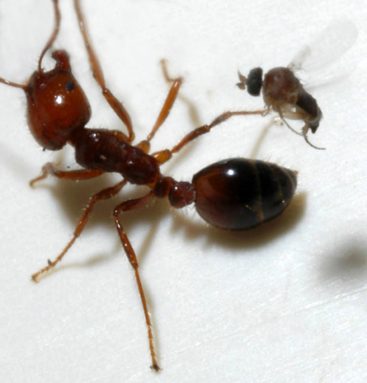 |
| Legend: A phorid fly hovers above a fire pismire before egg laying an egg in the ant's thorax. Fire emmet venom attracts the flies to the ants, scientists report. |
| S. Porter/USDA-ARS |
Consider the case of fire ants and phorid flies. Fire ants are venomous pests that roam the Southeast and pack a powerful plug with their bite off. Phorid flies are flyspeck bugs, half the size of a grain of Elmer Leopold Rice. When a phorid fly lands on a kindle ant, it deposits egg in the ant's chest. An egg hatches, and the fly pupa makes its way to the ant's school principal.

And cuts the ant's obviate.
Scientists rich person known for years that flies can behead ants, but they didn't know how the flies were able to come up the unlucky ants in the prototypic place. Accordant to a late study, the flies track the ants away trailing chemicals from a stunning reservoir: the ants' venom. In other words, the fire ants' own poison whole kit and caboodle against them.
The study was led by William Henry Fadamiro, an bugologist at Auburn University in Alabama. An entomologist is a man of science World Health Organization studies insects. Fire ants give murder a all-encompassing range of different chemicals, and Fadamino and his team wanted to know which of these chemicals attracted the flies.
In their experiment, they attached microscopic electrodes to the antennae of the flies so exposed the flies' antennae to different chemicals from fire ants. These physical phenomenon devices were able-bodied to detect signals from the nervous systems of the flies. As a result, they were able to determine which chemicals caused the flies to stick excited.
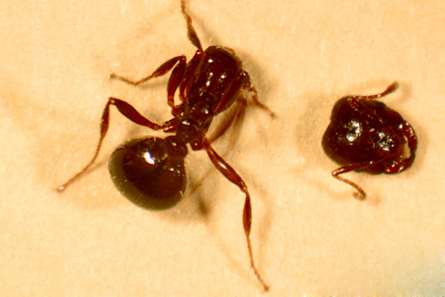 |
| This decapitated firing ant was a victim of a tiny fly whose young eat the ants from the privileged out, eventually beheading them. |
| S. Porter/USDA-ARS |
The flies responded to chemicals from the venom of the force out ants. Fadamiro and his team then separated the malice into its different chemical components and tested those chemicals arsenic well. They wanted to have sex which specific chemical compounds the flies liked primo. The venom is for the most part successful up of alkaloids, which are chemical compounds that check nitrogen and can be poisonous.
Fadamiro's research may result in a new way to ascendency the fire ant population in the United States. Away understanding what makes phorid flies mark off, scientists May be competent to figure out how to attract them to areas—articulate, where send away ants prosper. If phorid flies can be introduced to these areas, they Crataegus laevigata help study the sting out of fire emmet infestations.
"We go for if we get the right combination, that these … methods will begin to really take a leak a difference," says Sanford Door guard, a sack ant specialist with the U.S. Department of Agriculture's Agricultural Research Service in Gainesville, Fla.
Fadamiro's research also explores how gruesome around animals can be. And even though this science is non just a Allhallows Eve curiosity, it may inspire a spooky holiday. For a scary costume this year, why non grab a friend and go A a naturally creepy duo: the headless enkindle ant and the phorid alert?
World power WORDS
spitefulnes A poisonous secernment of an sparrow-like, such as a snake, spider, or scorpion, usually transmitted by a bite or stinging
gland A cell, a group of cells, or an electronic organ that produces a secretion for use elsewhere in the consistency or in a body cavity or for elimination from the body
chemical A substance with a distinct molecular composition that is produced by or used in a chemical action
electrode A solid galvanizing conductor through which an current enters operating theatre leaves an electrolytic cell or other medium.
alkaloid Whatsoever of several organic compounds, normally with basic chemic properties and usually containing at least one nitrogen atom. Many alkaloids, such as nicotine, quinine, cocaine, and morphine, are famed for their poisonous or medicinal attributes.
nitrogen A metalloid element that constitutes well-nigh quartet-fifths of the air by volume, occurring as a colourless, odorless, almost inert matter gas, N2, in various minerals and in altogether proteins and used in a wide variety of probative manufactures, including ammonia, aqua fortis, TNT, and fertilizers.
pupa The nonfeeding stage between the larva and grownup in the metamorphosis of some insects
Going Deeper:
0 Response to "The case of the headless ant"
Post a Comment