If a President Becomes Predident Again Does His Number Change?
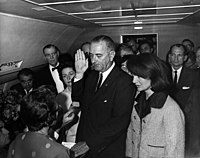
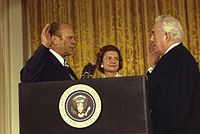
The United States presidential line of succession is the lodge in which the vice president of the United States and other officers of the United States federal government assume the powers and duties of the U.Southward. presidency (or the office itself, in the example of succession by the vice president) upon an elected president'southward death, resignation, removal from office upon impeachment conviction or incapacity.
The order of succession specifies that the office passes to the vice president; if the vice presidency is simultaneously vacant, or if the vice president is also incapacitated, the powers and duties of the presidency pass to the speaker of the Firm of Representatives, president pro tempore of the Senate, and then Cabinet secretaries, depending on eligibility.
Presidential succession is referred to multiple times in the U.S. Constitution – Article 2, Section 1, Clause 6, also as the 12th Subpoena, 20th Subpoena, and 25th Amendment. The vice president is designated as beginning in the presidential line of succession by the Article II succession clause, which also authorizes Congress to provide for a line of succession beyond the vice president; it has done so on three occasions. The electric current Presidential Succession Act was adopted in 1947, and terminal revised in 2006. The 25th Amendment also establishes procedures for filling an intra-term vacancy in the function of the vice president.
The Presidential Succession Human action refers specifically to officers beyond the vice president acting as president rather than becoming president when filling a vacancy. The Cabinet currently has 15 members, of which the secretary of land is beginning in line; the other Cabinet secretaries follow in the society of when their departments (or the section of which their department is the successor) were created. Those heads of department who are constitutionally non "eligible to the Part of President" are disqualified from assuming the powers and duties of the president through succession, and skipped to the adjacent in line. Since 1789, the vice president has succeeded to the presidency intra-term on nine occasions: eight times due to the incumbent's death, and one time due to resignation. No one lower in the line of succession has ever been called upon to deed every bit president.
Widely considered a settled issue during the belatedly 20th century, the terrorist attacks of September xi, 2001 demonstrated the potential for a decapitation strike that would impale or incapacitate multiple individuals in the presidential line of succession in addition to many members of Congress and the federal judiciary. In the years immediately following the attacks, numerous wide-ranging discussions were started, in Congress, amid academics and within the public policy community nearly continuity of authorities concerns including the existing constitutional and statutory provisions governing presidential succession. These discussions remain ongoing. One effort put forward by the Continuity of Government Committee, a nonpartisan think tank, produced three reports (2003, 2009 and 2011), the second of which focused on the implicit ambiguities and limitations in the electric current succession human action, and contained recommendations for amending the laws for succession to the presidency.
Current order of succession
The current presidential social club of succession was established by the Presidential Succession Deed of 1947, as amended.[ane] The order consists of congressional officers followed by the members of the chiffonier in the order of the institution of each department, provided that each officeholder must satisfy the ramble requirements for serving as president.[two] In the table, the absence of a number in the beginning column indicates that the incumbent is ineligible.
| No. | Part[3] | Incumbent | Party | |
|---|---|---|---|---|
| ane | Vice President | Kamala Harris | Autonomous | |
| ii | Speaker of the House of Representatives | Nancy Pelosi | Democratic | |
| iii | President pro tempore of the Senate | Patrick Leahy | Autonomous | |
| 4 | Secretary of State | Antony Blinken | Democratic | |
| 5 | Secretary of the Treasury | Janet Yellen | Democratic | |
| 6 | Secretary of Defense | Lloyd Austin | Unknown | |
| seven | Chaser Full general | Merrick Garland | Unknown | |
| 8 | Secretary of the Interior | Deb Haaland | Democratic | |
| ix | Secretary of Agriculture | Tom Vilsack | Democratic | |
| x | Secretary of Commerce | Gina Raimondo | Democratic | |
| 11 | Secretary of Labor | Marty Walsh | Democratic | |
| 12 | Secretarial assistant of Health and Human being Services | Xavier Becerra | Democratic | |
| 13 | Secretary of Housing and Urban Development | Marcia Fudge | Autonomous | |
| 14 | Secretarial assistant of Transportation | Pete Buttigieg | Democratic | |
| –[A] | Secretary of Energy | Jennifer Granholm | Democratic | |
| xv | Secretary of Didactics | Miguel Cardona | Democratic | |
| 16 | Secretarial assistant of Veterans Affairs | Denis McDonough | Autonomous | |
| –[A] | Secretary of Homeland Security | Alejandro Mayorkas | Unknown | |
Constitutional provisions
Presidential eligibility
Article Ii, Section 1, Clause 5 of the Constitution sets three qualifications for property the presidency: One must exist a natural-built-in denizen of the Us, be at least 35 years of age and have been a resident in the United States for at to the lowest degree fourteen years.[iv] [B]
Presidential succession
The presidential line of succession is mentioned in 4 places in the Constitution:
- Commodity Two, Section 1, Clause 6 makes the vice president first in the line of succession and allows the Congress to provide by police force for cases in which neither the president nor vice president tin serve.[vi]
- The 12th Amendment provided that the vice president would too fill any vacancy of the presidency arising from failure of the House of Representatives to choose a president in a contingent ballot.[7]
- The 20th Amendment, Section 3, supersedes the above 12th Amendment provision, by declaring that if the president-elect dies before his term begins, the vice president-elect becomes president on Inauguration Day and serves for the full term to which the president-elect was elected, and also that, if on Inauguration Day, a president has not been chosen or the president-elect does not authorize for the presidency, the vice president-elect acts as president until a president is called or the president-elect qualifies. It also authorizes Congress to provide for instances in which neither a president-elect nor a vice president-elect have qualified.[8]
- The 25th Amendment, Department 1, clarifies Commodity II, Section one, Clause 6, by stating unequivocally that the vice president is the directly successor of the president, and becomes president if the incumbent dies, resigns or is removed from part. It also, in sections 3 and 4, provides for situations where the president is temporarily disabled, such equally if the president has a surgical procedure or becomes mentally unfit, establishing procedures whereby the vice president can become acting president. Additionally, in Section two, the amendment provides a mechanism for intra-term vice presidential succession, establishing that a vice presidential vacancy will exist filled past a president'due south nominee upon confirmation past a bulk vote of both houses of Congress.[C] Previously, whenever a vice president had succeeded to the presidency or had died or resigned from office, the vice presidency remained vacant until the side by side presidential and vice presidential terms began; at that place were 16 such vacancies prior to 1967.[10]
Succession acts
Human action of 1792
The Presidential Succession Act of 1792 (Total text ) provided for succession after the president and vice president: starting time, the president pro tempore of the Senate, followed by the speaker of the House.[xi] The statute provided that the presidential successor would serve in an acting capacity, holding office only until a new president could be elected.[12] A special ballot was to be held in Nov of the year in which dual vacancies occurred (unless the vacancies occurred after the start Wednesday in Oct, in which instance the election would occur the following year; or unless the vacancies occurred within the last twelvemonth of the presidential term, in which instance the next election would accept identify as regularly scheduled). The persons elected president and vice president in such a special election would take served a full 4-year term beginning on March iv of the adjacent yr. No such election e'er took place.[13]
Various framers of the Constitution, such equally James Madison, criticized the system every bit being opposite to their intent. The decision to build the line of succession around those two officials was made after a long and contentious fence. In addition to the president pro tempore and the speaker, both the secretary of country and the main justice of the Supreme Court were too suggested.[13] Including the secretarial assistant of land was unacceptable to most Federalists, who did not want the then secretary of country, Thomas Jefferson, who had become the leader of the opposition Democratic-Republicans, to follow the vice president in the succession, and many objected to including the primary justice due to separation of powers concerns.[6] [14]
Deed of 1886
The Presidential Succession Act of 1886 (Full text) established succession to include the members of the president's chiffonier in the society of the establishment of the diverse departments, get-go with the secretarial assistant of state,[D] and stipulated that any official discharging the powers and duties of the presidency must possess the ramble qualifications to hold the office.[12] The president pro tempore and speaker were excluded from the new line, and the provision mandating a special presidential election when a double vacancy arose was too dropped.[13]
The need for increasing the number of presidential successors was abundantly clear to Congress, for twice inside the span of four years information technology happened that there was no one in the presidential line of succession. In September 1881, when Chester A. Arthur succeeded to the presidency following James A. Garfield's death, there was no vice president, no president pro tempore of the Senate, and no speaker of the House of Representatives.[7] Then, in November 1885, Grover Cleveland faced a similar state of affairs, following the death of Vice President Thomas A. Hendricks, as the Senate and the Business firm had not convened yet to elect new officers.[xv]
Act of 1947
The Presidential Succession Act of 1947 (Total text), which was signed into law on July 18, 1947,[12] restored the speaker of the Firm and president pro tempore of the Senate to the line of succession—but in reverse-club from their 1792 positions—and placed them ahead of the members of the Cabinet, positioned, as before, in the order of the establishment of their department.[3] [Eastward]
Placing the speaker and the president pro tempore (both elected officials) back in the succession and placing them alee of cabinet members (all of whom are appointed by the president with the advice and consent of the Senate), was Harry S. Truman's idea. Personally conveyed to Congress in June 1945, two months later on condign president upon Franklin D. Roosevelt'due south death, the proposal reflected Truman's belief that the president should not have the power to appoint to office "the person who would be my immediate successor in the consequence of my own death or inability to act," and that the presidency should, whenever possible, "exist filled by an elective officer."[12] [16]
Further amendments
The 1947 human activity has been modified several times, with changes being fabricated equally the face of the federal bureaucracy has changed over the ensuing years. Its near recent change came near in 2006, when the Usa PATRIOT Improvement and Reauthorization Act added the secretary of homeland security to the presidential line of succession.[17] [F]
Ambiguities regarding succession and inability

Although the Presidential Succession Clause in Article 2 of the Constitution clearly provided for the vice president to take over the "powers and duties" of the presidency in the event of a president's removal, death, resignation, or inability, left unclear was whether the vice president became president of the United States or simply temporarily acted as president in a example of succession.[half dozen] Some historians, including Edward Corwin and John D. Feerick,[nineteen] have argued that the framers' intention was that the vice president would remain vice president while executing the powers and duties of the presidency until a new president could exist elected.[20]
The hypothetical debate well-nigh whether the office or merely the powers of the office devolve upon a vice president who succeeds to the presidency between elections became an urgent constitutional issue in 1841, when President William Henry Harrison died in office, only 31 days into his term. Vice President John Tyler claimed a constitutional mandate to carry out the total powers and duties of the presidency, asserting he was the president and not but a temporary acting president, by taking the presidential oath of office.[21]
Many around him—including John Quincy Adams,[19] [22] Henry Dirt[23] and other members of Congress,[22] [23] along with Whig party leaders,[23] and even Tyler's ain cabinet[22] [23]—believed that he was only acting equally president and did non have the office itself. He was nicknamed "His Accidency" and excoriated equally a usurper.[21] Nonetheless, Tyler adhered to his position, even returning, unopened, mail addressed to the "Acting President of the The states" sent by his detractors.[24] Tyler's view ultimately prevailed when the Firm and Senate voted to accept the championship "President",[23] setting a precedent for an orderly transfer of presidential ability following a president's death,[21] 1 that was after written into the Constitution every bit department ane of the Twenty-5th Amendment.[20]
Even after the precedent regarding presidential succession due to the president's decease was prepare, the role of the Presidential Succession Clause that provided for replacing a disabled president remained unclear. What constituted an "inability"? Who determined the existence of an inability? Did a vice president go president for the rest of the presidential term in the example of an inability; or was the vice president but "acting as President"? Due to this lack of clarity, subsequently vice presidents were hesitant to assert any role in cases of presidential disability.[25] Two situations are noteworthy:
- On July 2, 1881, President James A. Garfield was shot; hit from backside by two bullets (one grazing his arm and the other lodging in his back).[26] The president wavered betwixt life and death for fourscore days afterwards the shooting; it was the first time that the nation equally a whole experienced the uncertainties associated with a prolonged menstruum of presidential inability.[seven] Most disconcerting, particularly for Garfield administration personnel and members of Congress, was the lack of constitutional guidance on how to handle the state of affairs. No one was sure who, if anyone, should exercise presidential authority while the president was disabled; many urged Vice President Chester A. Arthur to step up, but he declined, fearful of being labeled a usurper. Aware that he was in a fragile position and that his every action was placed under scrutiny, Arthur remained secluded in his New York City habitation for about of the summertime. Members of the Garfield Cabinet conferred daily with the president's doctors and kept the vice president informed of meaning developments on the president'southward condition.[26]
- In October 1919, President Woodrow Wilson suffered a debilitating stroke. Most blind and partially paralyzed, he spent the final 17 months of his presidency sequestered in the White House.[27] Vice President Thomas R. Marshall, the cabinet, and the nation were kept in the nighttime over the severity of the president's disease for several months. Marshall was pointedly afraid to enquire about Wilson'due south health, or to preside over chiffonier meetings, fearful that he would be accused of "longing for his place". Though members of both parties in Congress pledged to support him if he asserted his claim to the presidential powers and duties, Marshall declined to act, or to do anything that might seem ambitious or disloyal to Wilson.[28] At a fourth dimension when the fight over joining the League of Nations was reaching a climax, and domestic issues such as strikes, unemployment, inflation and the threat of Communism were demanding action, the operations of the executive branch were once more hampered due to the fact that there was no constitutional ground for declaring that the president was unable to function.[29]
When President Dwight D. Eisenhower suffered a middle attack in September 1955, he and Vice President Richard Nixon adult an informal plan authorizing Nixon to assume some administrative duties during Eisenhower's recovery. Although information technology did not have the forcefulness of law, the plan helped to reassure the nation. The agreement also independent a provision whereby Eisenhower could declare his own inability and, if unable to do then, empowered Nixon, with appropriate consultation, to make the decision.[25] Had it been invoked, Nixon would have served as acting president until the president issued a declaration of his recovery. Moved forrad every bit a upshot of President Kennedy's November 1963 assassination, this informal program evolved into constitutional procedure a decade later through Sections 3 and four of the Twenty-fifth Amendment, which resolved the uncertainties surrounding presidential disability.[ten]
Presidential succession by vice presidents
Nine vice presidents have succeeded to the presidency intra-term, viii due to the president'due south death, and one due to the president's resignation from office.[7] [17]
| Successor[30] | Party[30] | President | Reason | Date of succession[xxx] [31] | |
|---|---|---|---|---|---|
| John Tyler | Whig | William Henry Harrison | Death | April iv, 1841, 31 days into Harrison's presidency.[32] | |
| Millard Fillmore | Whig | Zachary Taylor | Death | July 9, 1850, 1 year, 4 months and v days into Taylor's presidency.[33] | |
| Andrew Johnson | National Spousal relationship | Abraham Lincoln | Decease | April xv, 1865, 4 years, 1 month and 11 days into Lincoln's presidency.[34] | |
| Chester A. Arthur | Republican | James A. Garfield | Death | September xix, 1881, half-dozen months and 15 days into Garfield's presidency.[35] | |
| Theodore Roosevelt | Republican | William McKinley | Death | September 14, 1901, 4 years, 6 months and 10 days into McKinley'southward presidency.[36] | |
| Calvin Coolidge | Republican | Warren Yard. Harding | Death | August 2, 1923, two years, 4 months and 29 days into Harding's presidency.[37] | |
| Harry S. Truman | Democratic | Franklin D. Roosevelt | Death | Apr 12, 1945, 12 years, ane month and 8 days into Roosevelt'due south presidency.[38] | |
| Lyndon B. Johnson | Autonomous | John F. Kennedy | Death | Nov 22, 1963, ii years, 10 months and 2 days into Kennedy's presidency.[39] | |
| Gerald Ford | Republican | Richard Nixon | Resignation | August 9, 1974, five years, 6 months and 20 days into Nixon's presidency.[40] | |
Additionally, three vice presidents take temporarily assumed the powers and duties of the presidency as acting president, equally authorized by Department 3 of the Twenty-fifth Amendment: George H. Due west. Bush-league did and so in one case, on July xiii, 1985; Dick Cheney did so twice, on June 29, 2002 and once more on July 21, 2007; and Kamala Harris did so on November 19, 2021.[41] [42]
Presidential succession beyond the vice president
While several vice presidents accept succeeded to the presidency upon the death or resignation of the president, and a number of them have died or resigned, the offices of president and vice president take never been simultaneously vacant;[G] [H] thus no other officer in the presidential line of succession has ever been called upon to act as president. There was potential for such a double vacancy when John Wilkes Booth assassinated President Abraham Lincoln in 1865, equally Vice President Andrew Johnson was also targeted (forth with Secretary of Land William Seward and peradventure General Ulysses S. Grant) every bit office of Berth'due south plot to destabilize the Union authorities.[47] It again became a real possibility 3 years subsequently, when, with the vice presidency vacant, Johnson as president was impeached by the House of Representatives and faced removal from office if bedevilled at trial in the Senate. President Johnson was acquitted by a 1-vote margin.[48]
Ratification of the 25th Amendment, with its mechanism for filling an intra-term vice presidential vacancy, has made calling on the speaker, president pro tempore, or a cabinet member to serve equally acting president unlikely to happen, except in the backwash of a catastrophic effect. But a few years after the subpoena went into upshot, in October 1973, at the summit of Watergate, Vice President Spiro Agnew resigned. With Agnew's unexpected departure, and the state of Richard Nixon'south presidency, Speaker of the House Carl Albert was suddenly beginning in line to get acting president. The vacancy continued until Gerald Ford was sworn in as vice president on December 6, 1973.[49] Albert was also adjacent in line from the time Ford assumed the presidency on August ix, 1974, following Nixon's resignation from office, until Ford's option to succeed himself as vice president, Nelson Rockefeller, was confirmed by Congress 4 months later.[7]
Adjacent in line
The vice presidency has been vacant on eighteen occasions since 1789;[31] during those periods, the following people have been next in line to serve as acting president:
Under the 1792 succession act
| No. | Official (party) | Dates | Reason | President (party) | ||
|---|---|---|---|---|---|---|
| 1 | William H. Crawford (D-R)[50] President pro tempore of the Senate | Apr xx, 1812 – | Death of Vice President George Clinton | Madison (D-R) | ||
| 2 | Langdon Cheves (D-R)[51] Speaker of the Firm | November 23, 1814 – | Death of Vice President Elbridge Gerry, and vacancy in office of president pro tempore of the Senate | Madison (D-R) | ||
| John Gaillard (D-R)[51] President pro tempore of the Senate | Nov 25, 1814 – | John Gaillard elected president pro tempore of the Senate, and continuing intra-term vacancy in vice presidency | ||||
| 3 | Hugh Lawson White (D)[51] President pro tempore of the Senate | December 28, 1832 – | Resignation of Vice President John C. Calhoun | Jackson (D) | ||
| 4 | Samuel 50. Southard (West)[52] President pro tempore of the Senate | Apr 4, 1841 – | Expiry of President William Henry Harrison and accession of Vice President John Tyler to presidency | Tyler (Westward) | ||
| Willie Person Mangum (W) [52] President pro tempore of the Senate | May 31, 1842 – | Willie Person Mangum elected president pro tempore of the Senate, and continuing intra-term vacancy in vice presidency | ||||
| 5 | Vacant [53] | July ix, 1850 – | Death of President Zachary Taylor and accession of Vice President Millard Fillmore to presidency, vacancy in part of president pro tempore of the Senate, and ineligibility of Speaker of the House Howell Cobb[I] | Fillmore (Due west) | ||
| William R. Male monarch (D)[54] President pro tempore of the Senate | July xi, 1850 – | William R. King elected president pro tempore of the Senate, and continuing intra-term vacancy in vice presidency | ||||
| David Rice Atchison (D)[55] President pro tempore of the Senate | Dec 20, 1852 – | David Rice Atchison elected president pro tempore of the Senate, and standing intra-term vacancy in vice presidency | ||||
| half dozen | David Rice Atchison (D)[53] President pro tempore of the Senate | Apr xviii, 1853 – | Death of Vice President William R. Rex | Pierce (D) | ||
| Lewis Cass (D)[53] President pro tempore of the Senate | Dec 4, 1854 – | Lewis Cass elected president pro tempore of the Senate, and standing intra-term vacancy in vice presidency | ||||
| Jesse D. Bright (D)[53] President pro tempore of the Senate | December v, 1854 – | Jesse D. Bright elected president pro tempore of the Senate, and continuing intra-term vacancy in vice presidency | ||||
| Charles E. Stuart (D)[53] President pro tempore of the Senate | June ix, 1856 – | Charles E. Stuart elected president pro tempore of the Senate, and continuing intra-term vacancy in vice presidency | ||||
| Jesse D. Bright (D)[53] President pro tempore of the Senate | June 11, 1856 – | Jesse D. Brilliant elected president pro tempore of the Senate, and continuing intra-term vacancy in vice presidency | ||||
| James Murray Mason (D)[53] President pro tempore of the Senate | January half-dozen, 1857 – | James Murray Bricklayer elected president pro tempore of the Senate, and continuing intra-term vacancy in vice presidency | ||||
| vii | Lafayette S. Foster (R)[56] President pro tempore of the Senate | Apr 15, 1865 – | Decease of President Abraham Lincoln and accession of Vice President Andrew Johnson to presidency | A. Johnson (NU) | ||
| Benjamin Wade (R)[56] President pro tempore of the Senate | March two, 1867 – | Benjamin Wade elected president pro tempore of the Senate, and continuing intra-term vacancy in vice presidency | ||||
| 8 | Thomas W. Ferry (R)[57] President pro tempore of the Senate | November 22, 1875 – | Decease of Vice President Henry Wilson | Grant (R) | ||
| 9 | Vacant [58] | September 19, 1881 – | Death of President James A. Garfield and accession of Vice President Chester A. Arthur to presidency, and vacancy in office of president pro tempore of the Senate and in office of speaker of the Business firm | Arthur (R) | ||
| Thomas F. Bayard (D)[59] President pro tempore of the Senate | October ten, 1881 – | Thomas Eastward. Bayard elected president pro tempore of the Senate, and continuing intra-term vacancy in vice presidency | ||||
| David Davis (I)[59] President pro tempore of the Senate | October thirteen, 1881 – | David Davis elected president pro tempore of the Senate, and continuing intra-term vacancy in vice presidency | ||||
| George F. Edmunds (R)[59] President pro tempore of the Senate | March 3, 1883 – | George F. Edmunds elected president pro tempore of the Senate, and continuing intra-term vacancy in vice presidency | ||||
| 10 | Vacant [58] | November 25, 1885 – | Death of Vice President Thomas A. Hendricks, and vacancy in office of president pro tempore of the Senate and in office of speaker of the Business firm | Cleveland (D) | ||
| John Sherman (R)[58] President pro tempore of the Senate | December 7, 1885 – | John Sherman elected president pro tempore of the Senate, and standing intra-term vacancy in vice presidency | ||||
Under the 1886 succession deed
| No. | Official (party) | Dates | Reason | President (party) | ||
|---|---|---|---|---|---|---|
| 10 | Thomas F. Bayard (D)[22] Secretary of State | Jan 19, 1886 – | Succession Act of 1886 is enacted, and continuing intra-term vacancy in vice presidency | Cleveland (D) | ||
| xi | John Hay (R)[sixty] Secretary of State | November 21, 1899 – | Death of Vice President Garret Hobart | McKinley (R) | ||
| 12 | John Hay (R)[sixty] Secretary of State | September fourteen, 1901 – | Death of President William McKinley and accession of Vice President Theodore Roosevelt to presidency | T. Roosevelt (R) | ||
| 13 | Philander C. Knox (R) Secretary of State | October thirty, 1912 – | Decease of Vice President James S. Sherman | Taft (R) | ||
| 14 | Charles Evans Hughes (R) Secretary of State | August 2, 1923 – | Death of President Warren G. Harding and accession of Vice President Calvin Coolidge to the presidency | Coolidge (R) | ||
| 15 | Edward Stettinius Jr. (D)[61] Secretary of State | Apr 12, 1945 – | Death of President Franklin D. Roosevelt and accession of Vice President Harry S. Truman to the presidency | Truman (D) | ||
| Henry Morgenthau Jr. (D)[61] Secretary of the Treasury | June 27, 1945 – | Resignation of Secretarial assistant of State Edward Stettinius Jr., and continuing intra-term vacancy in vice presidency | ||||
| James F. Byrnes (D)[61] Secretary of State | July 3, 1945 – | James F. Byrnes confirmed as Secretarial assistant of State, and standing intra-term vacancy in vice presidency | ||||
| George Marshall (D)[lx] Secretary of State | January 21, 1947 – | George Marshall confirmed equally Secretary of State, and standing intra-term vacancy in vice presidency | ||||
Nether the 1947 succession act
| No. | Official (political party) | Dates | Reason | President (party) | ||
|---|---|---|---|---|---|---|
| 15 | Joseph W. Martin Jr. (R)[sixty] Speaker of the Business firm | July eighteen, 1947 – | Succession Human action of 1947 is enacted, and standing intra-term vacancy in vice presidency | Truman (D) | ||
| Sam Rayburn (D)[62] Speaker of the House | January 3, 1949 – | Sam Rayburn elected speaker of the House, and continuing intra-term vacancy in vice presidency | ||||
| 16 | John W. McCormack (D)[63] Speaker of the House | November 22, 1963 – | Death of President John F. Kennedy and accession of Vice President Lyndon B. Johnson to the presidency | Fifty. Johnson (D) | ||
| 17 | Carl Albert (D)[49] Speaker of the House | October x, 1973 – | Resignation of Vice President Spiro Agnew | Nixon (R) | ||
| xviii | Carl Albert (D)[7] Speaker of the Firm | August 9, 1974 – | Resignation of President Richard Nixon and accession of Vice President Gerald Ford to the presidency | Ford (R) | ||
Contemporary bug and concerns
In 2003, the Continuity of Government Commission suggested that the current law has "at least vii meaning issues ... that warrant attending," specifically:
- The reality that all figures in the current line of succession work and reside in the vicinity of Washington, D.C. In the event of a nuclear, chemic, or biological assault, it is possible that everyone on the list would exist killed or incapacitated. For this concern, i of the listed people is selected every bit "designated survivor" and stays on another secret location during certain events where all others are present.
- Doubt that the speaker of the Firm and the president pro tempore of the Senate are constitutionally eligible to act as president.
- A concern about the wisdom of including the president pro tempore in the line of succession as the "largely honorific postal service traditionally held by the longest-serving senator of the majority party". For example, from Jan 20, 2001, to June 6, 2001, the president pro tempore was then-98-twelvemonth-old Strom Thurmond.
- A business organisation that the current line of succession can strength the presidency to abruptly switch parties mid-term, as the president, speaker, and the president pro tempore are not necessarily of the same political party equally each other.
- A concern that the succession line is ordered by the dates of cosmos of the various executive departments, without regard to the skills or capacities of the persons serving as secretarial assistant.
- The fact that, should a Chiffonier member begin to act as president, the police force allows the Business firm to elect a new speaker (or the Senate to elect a new president pro tempore), who could in consequence remove the Cabinet fellow member and assume the part themselves at any time.
- The absence of a provision where a president is disabled and the vice presidency is vacant (for example, if an assassination endeavor simultaneously wounded the president and killed the vice president).[64]
In 2009, the Continuity of Regime Commission commented on the utilise of the term "Officer" in the 1947 statute,
The language in the current Presidential Succession Act is less articulate than that of the 1886 Act with respect to Senate confirmation. The 1886 Act refers to "such officers as shall accept been appointed past the communication and consent of the Senate to the office therein named …" The current human action merely refers to "officers appointed, by and with the advice and consent of the Senate." Read literally, this means that the current human action allows for acting secretaries to exist in the line of succession as long as they are confirmed past the Senate for a mail service (even for example, the 2nd or 3rd in command inside a department). It is common for a second in command to become acting secretarial assistant when the secretary leaves office. Though there is some dispute over this provision, the language clearly permits acting secretaries to be placed in the line of succession. (We accept spoken to acting secretaries who told u.s.a. they had been placed in the line of succession.)[65]
In 2016–17, the Second Fordham University Schoolhouse of Law Clinic on Presidential Succession developed a serial of proposals to "resolve succession problems that have received piddling attending from scholars and commissions" over the by several decades; its recommendations included:
- Removing legislators and several Cabinet members from the line of succession and adding 4 officials, or "Standing Successors", exterior of Washington, D.C. The line of succession would be: 1st—Secretarial assistant of State, 2d—Secretarial assistant of Defence, tertiary—Attorney General, quaternary—Secretary of Homeland Security, 5th—Secretarial assistant of the Treasury, sixth—Standing Successor 1, 7th—Standing Successor 2, 8th—Continuing Successor iii, and ninth—Standing Successor iv;
- If legislators are not removed from the line of succession, only designate them as successors in cases where the president dies or resigns, non where he is disabled (to protect legislators from existence forced to resign to act as president temporarily) or removed from office;
- Eliminate the "bumping provision" in the Succession Act of 1947;
- Analyze the ambiguity in the Succession Human action of 1947 as to whether acting Cabinet secretaries are in the line of succession;
- That the outgoing president nominate and the Senate confirm some of the incoming president'south Chiffonier secretaries prior to Inauguration Day, which is a detail bespeak of vulnerability for the line of succession;
- Found statutory procedures for declaring 1) a dual inability of the president and the vice president, including where in that location is no vice president and two) a sole inability of the vice president.[66]
Run into also
- Fundamental Locator System
- Designated survivor
- List of United states presidential assassination attempts and plots
- United States presidential line of succession in fiction
Notes
- ^ a b Ineligible due to being a naturalized citizen, not natural-born.
- ^ The concluding sentence of the 12th Amendment explicitly states that the constitutional qualifications for holding the presidency likewise employ to being vice president.[five]
- ^ This section 2 of the 25th Subpoena has been invoked twice: 1973—Gerald Ford was nominated and confirmed to office following Spiro Agnew's resignation. 1974—Nelson Rockefeller was nominated and confirmed to office after Gerald Ford became president upon Richard Nixon's resignation.
- ^ Secretarial assistant of State, Secretarial assistant of the Treasury, Secretarial assistant of War, Attorney-General, Postmaster-General, Secretary of the Navy, and Secretary of the Interior.
- ^ Secretary of Land, Secretary of the Treasury, Secretary of War, Chaser General, Postmaster Full general, Secretary of the Navy, Secretary of the Interior, Secretary of Agronomics, Secretary of Commerce, Secretarial assistant of Labor.
- ^ 1947—substituted Secretary of Defense force for Secretary of War and struck out Secretary of the Navy. 1965—added Secretarial assistant of Health, Education, and Welfare and also Secretary of Housing and Urban Evolution. 1966—added Secretary of Transportation. 1970—removed Postmaster General. 1977—added Secretarial assistant of Free energy. 1979—substituted Secretary of Health and Human Services for Secretary of Health, Teaching, and Welfare and added Secretary of Teaching. 1988—Secretary of Veterans Diplomacy. 2006—Secretary of Homeland Security.[18]
- ^ Various friends and colleagues of Senator David Rice Atchison asserted that both offices were vacant on March 4–five, 1849, considering the terms of President Zachary Taylor and Vice President Millard Fillmore began on March iv, just neither took their oath of office on that day – following precedent as the day fell on a Sun. The inauguration was held the next day, Monday, March 5.[43] Consequently, they considered David Rice Atchison, by virtue of being the final president pro tempore of the Senate in the out-going Congress, to have been Acting President of the United States during the 24-hour interval-long Interregnum in accordance with the Presidential Succession Act of 1792. Historians, constitutional scholars and biographers all dismiss the claim. Atchison did not accept the presidential adjuration of office either, and his term as president pro tempore had expired on March four.[44]
- ^ 1940 Republican presidential nominee Wendell Willkie and vice presidential nominee Charles L. McNary both died in 1944 (October 8, and February 25, respectively); the outset, and to date but time both members of a major-political party presidential ticket died during the term for which they sought ballot. Had they been elected, Willkie's death would have resulted in the Secretarial assistant of Land becoming interim president for the remainder of the term catastrophe on January xx, 1945, in accordance with the Presidential Succession Act of 1886.[45] [46]
- ^ Not still 35 years former.
References
- ^ "Title 3—The President: Chapter 1—Presidential Elections and Vacancies" (PDF). Washington, D.C.: U.Due south. Government Publishing Office. 2017. p. six. Retrieved January xviii, 2019.
- ^ "Order of Presidential Succession". PresidentsUSA.cyberspace. Baaron's Hill. Retrieved Jan 18, 2019.
- ^ a b Lord, Debbie (June xviii, 2018). "A president resigns, dies or is impeached: What is the line of succession?". WFTV.com. Cox Media Group. Retrieved June 18, 2018.
- ^ "Article II. The Executive Branch, Annenberg Classroom". The Interactive Constitution. Philadelphia, Pennsylvania: The National Constitution Center. Retrieved June xv, 2018.
- ^ Peabody, Bruce Chiliad.; Gant, Scott E. (February 1999). "The Twice and Future President: Constitutional Interstices and the Twenty-2nd Amendment". Minnesota Law Review. Minneapolis: University of Minnesota Constabulary School. 83 (3): 565–635. Archived from the original on Jan fifteen, 2013. Retrieved June 12, 2015.
- ^ a b c Feerick, John. "Essays on Article Ii: Presidential Succession". The Heritage Guide to the Constitution. The Heritage Foundation. Retrieved June 12, 2018.
- ^ a b c d eastward f Feerick, John D. (2011). "Presidential Succession and Disability: Before and After the Twenty-5th Amendment". Fordham Police Review. 79 (3): 907–949. Retrieved June 18, 2018.
- ^ Larson, Edward J.; Shesol, Jeff. "The Twentieth Amendment". The Interactive Constitution. Philadelphia, Pennsylvania: The National Constitution Center. Retrieved June 15, 2018.
- ^ a b Kalt, Brian C.; Pozen, David. "The 20-fifth Amendment". The Interactive Constitution. Philadelphia, Pennsylvania: The National Constitution Centre. Retrieved June 15, 2018.
- ^ Spivak, Joshua (October 14, 2015). "America'due south System for Presidential Succession is Ridiculous". Time . Retrieved June xviii, 2018.
- ^ a b c d Relyea, Harold C. (Baronial five, 2005). "Continuity of Government: Current Federal Arrangements and the Future" (PDF). CRS Study for Congress. Washington, D.C.: Congressional Enquiry Service, the Library of Congress. pp. 2–iv. Retrieved June 16, 2018.
- ^ a b c Hamlin, Charles Due south. (Jan 1905). "The Presidential Succession Act of 1886". Harvard Police Review. The Harvard Law Review Clan. 18 (3): 182–195. Retrieved March xiii, 2021 – via JSTOR.
- ^ Feerick, John D.; Freund, Paul A. (1965). From Failing Easily: the Story of Presidential Succession. New York City: Fordham Academy Press. pp. 57–62. LCCN 65-14917.
- ^ Lewis, Charlton Thomas; Willsey, Joseph H. (1895). Harper's Volume of Facts: a Classified History of the World; Embracing Scientific discipline, Literature, and Fine art. New York: Harper & Brothers. p. 884. LCCN 01020386. Retrieved April 24, 2011.
- ^ Truman, Harry S. (June xix, 1945). "Special Message to the Congress on the Succession to the Presidency". Online by Gerhard Peters and John T. Woolley, The American Presidency Project. Retrieved January 22, 2018.
- ^ a b "Succession: Presidential and Vice Presidential Fast Facts". CNN.com. Turner Broadcasting Organization, Inc. August 27, 2013. Retrieved June twenty, 2018.
- ^ "2016 US Code Title iii – The President Chapter one – Presidential Elections and Vacancies Sec. 19 – Vacancy in offices of both President and Vice President; officers eligible to act". US Law. Mountain View, California: Justia. Retrieved June 19, 2018.
- ^ a b Schlesinger, Arthur M., Jr. (Fall 1974). "On the Presidential Succession". Political Science Quarterly. 89 (3): 475, 495–496. doi:x.2307/2148451. JSTOR 2148451.
- ^ a b "Presidential Succession". US Law. Mountain View, California: Justia. Retrieved June 15, 2018.
- ^ a b c Freehling, William. "John Tyler: Domestic Diplomacy". Charllotesville, Virginia: Miller Center of Public Affairs, University of Virginia. Retrieved June 15, 2018.
- ^ a b c d Rankin, Robert S. (February 1946). "Presidential Succession in the United states of america". The Periodical of Politics. eight (1): 44–56. doi:10.2307/2125607. JSTOR 2125607. S2CID 153441210.
- ^ a b c d eastward Abbott, Philip (December 2005). "Accidental Presidents: Death, Assassination, Resignation, and Democratic Succession". Presidential Studies Quarterly. 35 (four): 627–645. doi:10.1111/j.1741-5705.2005.00269.ten. JSTOR 27552721.
- ^ Crapol, Edward P. (2006). John Tyler: the accidental president . UNC Printing Books. p. 10. ISBN978-0-8078-3041-3. OCLC 469686610.
- ^ a b Feerick, John. "Essays on Subpoena XXV: Presidential Succession". The Heritage Guide to the Constitution. The Heritage Foundation. Retrieved June 22, 2018.
- ^ a b Feerick, John D.; Freund, Paul A. (1965). From Failing Hands: the Story of Presidential Succession. New York City: Fordham University Press. pp. 118–127. LCCN 65-14917.
- ^ Bister, Saladin. "Woodrow Wilson: Life After The Presidency". Charllotesville, Virginia: Miller Eye of Public Affairs, Academy of Virginia. Retrieved June 23, 2018.
- ^ "Thomas R. Marshall, 28th Vice President (1913–1921)". Biographical Dictionary of the Us Congress 1774 – Present. Washington, D.C.: U.s. Congress. Retrieved June 23, 2018.
- ^ Cooper, John M. (2009). Woodrow Wilson: A Biography. Alfred A. Knopf. p. 555. ISBN978-0-307-26541-eight.
- ^ a b "Vice President of the U.s. (President of the Senate)". Washington, D.C.: Office of the Secretary, The states Senate. Retrieved June 20, 2018.
- ^ Freehling, William. "William Harrison: Decease of the President". Charllotesville, Virginia: Miller Center of Public Affairs, University of Virginia. Retrieved June 17, 2018.
- ^ Holt, Michael. "Zachary Taylor: Decease of the President". Charllotesville, Virginia: Miller Center of Public Affairs, University of Virginia. Retrieved June 17, 2018.
- ^ Burlingame, Michael. "Abraham Lincoln: Decease of the President". Charllotesville, Virginia: Miller Center of Public Affairs, University of Virginia. Retrieved June 17, 2018.
- ^ Freidel, Frank; Sidey, Hugh. "James Garfield". WhiteHouse.gov. From "The Presidents of the United states of america". (2006) Washington, D.C.: White House Historical Clan. Retrieved June 17, 2018.
- ^ Freidel, Frank; Sidey, Hugh. "William McKinley". WhiteHouse.gov. From "The Presidents of the United States of America". (2006) Washington D.C.: White Firm Historical Association. Retrieved June 17, 2018.
- ^ Trani, Eugene P. "Warren G. Harding: Death of the President". Charllotesville, Virginia: Miller Center of Public Affairs, Academy of Virginia. Retrieved June 17, 2018.
- ^ Freidel, Frank; Sidey, Hugh. "Franklin D. Roosevelt". WhiteHouse.gov. From "The Presidents of the U.s. of America". (2006) Washington D.C.: White House Historical Clan. Retrieved June 17, 2018.
- ^ Freidel, Frank; Sidey, Hugh. "John F. Kennedy". WhiteHouse.gov. From "The Presidents of the U.s.". (2006) Washington D.C.: White House Historical Clan. Retrieved June 17, 2018.
- ^ Hughes, Ken. "Richard Nixon: Life Later the Presidency". Charllotesville, Virginia: Miller Center of Public Affairs, University of Virginia. Retrieved June 17, 2018.
- ^ Olsen, Jillian (November nineteen, 2021). "How many other vice presidents have temporarily taken over presidential powers?". St. Petersburg, Florida. Retrieved November xix, 2021.
- ^ Sullivan, Kate (November nineteen, 2021). "For 85 minutes, Kamala Harris became the first woman with presidential power". CNN. Retrieved November 19, 2021.
- ^ "The 16th Presidential Inauguration: Zachary Taylor, March 5, 1849". Joint Congressional Committee on Countdown Ceremonies. Retrieved June 28, 2018.
- ^ Feerick, John D.; Freund, Paul A. (1965). From Failing Hands: the Story of Presidential Succession. New York City: Fordham University Press. pp. 100–101. LCCN 65-14917.
- ^ Brewer, F. (1945). "Succession to the presidency". Editorial inquiry reports 1945 (Vol. II). Washington, D.C.: CQ Press. Retrieved July 12, 2018.
If the Republican ticket had been elected in 1940, the plan of succession adopted in 1886 would probably have come up into operation for the first time in 1944. Charles McNary, Republican candidate for Vice President, died on Feb. 25, 1944, With the expiry of Wendell Willkie, on Oct. 8, his Secretary of State would have been sworn in for the rest of the term ending on Jan. twenty, 1945.
- ^ Feinman, Ronald L. (March one, 2016). "The Election of 1940 and the Might-Have-Been that Makes Ane Shudder". History News Network. Retrieved July 13, 2018.
- ^ "Booth's Reason for Assassination". Teachinghistory.org. Fairfax County, Virginia: Roy Rosenzweig Center for History and New Media at George Stonemason University. Retrieved January 18, 2019.
- ^ "The forgotten man who most became President after Lincoln". The constitution Daily. Philadelphia, Pennsylvania: The National Constitution Center. April 15, 2018. Retrieved June 25, 2018.
- ^ a b Gup, Ted (November 28, 1982). "Speaker Albert Was Set to Exist President". The Washington Post . Retrieved June 25, 2018.
- ^ "George Clinton, quaternary Vice President (1805–1812)". Washington, D.C.: Office of the Secretary, United States Senate. Retrieved June 30, 2018.
- ^ a b c Feerick, John D.; Freund, Paul A. (1965). From Failing Hands: the Story of Presidential Succession. New York City: Fordham University Press. pp. 84, 86. LCCN 65-14917.
- ^ a b "John Tyler, Tenth Vice President (1841)". Washington, D.C.: Function of the Secretary, The states Senate. Retrieved June xxx, 2018.
- ^ a b c d e f g Feerick, John D.; Freund, Paul A. (1965). From Failing Easily: the Story of Presidential Succession. New York City: Fordham Academy Press. pp. 104–105. LCCN 65-14917.
- ^ "William Rufus King, 13th Vice President (1853)". Washington, D.C.: Function of the Secretary, United States Senate. Retrieved June 30, 2018.
- ^ "President Pro Tempore". Washington, D.C.: Office of the Secretary, United states of america Senate. Retrieved June 29, 2018.
- ^ a b Bomboy, Scott (August 11, 2017). "5 little-known men who nearly became president". Constitution Daily. Philadelphia, Pennsylvania: National Constitution Centre. Retrieved July 1, 2018.
- ^ Feerick, John D.; Freund, Paul A. (1965). From Failing Hands: the Story of Presidential Succession. New York Metropolis: Fordham University Press. p. 116. LCCN 65-14917.
- ^ a b c Erickson, Nancy, ed. (Baronial 22, 2008). "Chapter 2: A Question of Succession, 1861-1889" (PDF). Pro tem : presidents pro tempore of the United States Senate since 1789. Washington, D.C.: U.S. Authorities Press office. pp. 55–57. ISBN978-0-16-079984-half dozen . Retrieved June 30, 2018.
- ^ a b c Feerick, John D.; Freund, Paul A. (1965). From Declining Hands: the Story of Presidential Succession. New York Urban center: Fordham University Press. pp. 131–132. LCCN 65-14917.
- ^ a b c d Feinman, Ronald L. (March 22, 2016). "These 11 People Came Close to Being President of the U.s. …". Seattle, Washington: History News Network. Retrieved July i, 2018.
- ^ a b c Feerick, John D.; Freund, Paul A. (1965). From Failing Hands: the Story of Presidential Succession. New York City: Fordham University Press. pp. 204–205. LCCN 65-14917.
- ^ "List of Speakers of the Business firm". Washington, D.C.: Function of the Clerk, U.South. House of Representatives. Retrieved June 29, 2018.
- ^ Feinman, Ronald L. (Nov 1, 2015). "Iii Speakers Of The Firm Who Were "A Heartbeat Away" From The Presidency!". TheProgressiveProfessor . Retrieved July 1, 2018.
- ^ "The Continuity of Congress: The Outset Report of the Continuity of Regime Commission" (PDF). Preserving Our Institutions. Washington, D.C.: Continuity of Government Commission. May 2003. p. 4. Archived from the original (PDF) on June 25, 2008. Retrieved Dec 28, 2008 – via Internet Archive.
- ^ "The Continuity of the Presidency: The 2nd Written report of the Continuity of Government Commission" (PDF). Preserving Our Institutions. Washington, D.C.: Continuity of Authorities Commission. June 2009. p. 34. Archived from the original (PDF) on May 23, 2012. Retrieved May 23, 2012 – via WebCite.
- ^ "2nd Fordham Academy School of Police force Clinic on Presidential Succession, Fifty Years After the Xx-Fifth Amendment: Recommendations for Improving the Presidential Succession System". Fordham Law Review. 86 (three): 917–1025. 2017. Retrieved June 25, 2018.
Further reading
- Baker, M. Miller (December 1, 2001). "Fools, Drunkards, & Presidential Succession". Federalist Society.
- Feerick, John D. (2011). "Presidential Succession and Inability: Earlier and Later on the Twenty-Fifth Amendment". Fordham Law Review. 79 (3): 907–949. Besides bachelor here.
- Neale, Thomas H. (Oct 3, 2008). Presidential Succession: Perspectives, Contemporary Analysis, and 110th Congress Proposed Legislation. Congressional Enquiry Service Report for Congress. RL34692.
- Whitney, Gleaves (2004). "Presidential Succession". Ask Gleaves. Paper 57. Grand Valley Country Academy.
Source: https://en.wikipedia.org/wiki/United_States_presidential_line_of_succession
0 Response to "If a President Becomes Predident Again Does His Number Change?"
Post a Comment